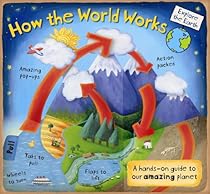
How the World Works: A Hands-On Guide to Our Amazing Planet
| Author | : | |
| Rating | : | 4.73 (726 Votes) |
| Asin | : | 0763648019 |
| Format Type | : | paperback |
| Number of Pages | : | 18 Pages |
| Publish Date | : | 2014-08-25 |
| Language | : | English |

DESCRIPTION:
She lives in Cornwall. Christiane Dorion is a writer and educational consultant who has taught about sustainable development for more than twenty years. . She lives in Surrey, England.Beverley Young has exhibited paintings in galleries throughout England
Dave C. said Three Stars. It seems Evolution is avoided. Otherwise, five stars.. "Five Stars" according to ROBERT R. FOWLER. GOOD. Fantastic, Educational and Fun Book! I bought this book at a botanical gardens gift store. It starts with the solar system, then moves on the Earth's origin. It explains, in kid-friendly terms, plate tectonics, ocean currents, the water and carbon cycles, plants and the food chain. I majored in Environmental Sciences and I thought this book was really well done, especially with the use of the pull/turn tabs and the 3D pop-ups. Even as an adult, I found the book fascinating, and I'm looking forward to giving this book to my 6 year old son and my 8 year old nephew for Christmas.I did not find this book to have a "green propaganda" as one revi
Packed with illustrations and paper fold-outs, flaps, pops, and more to boost interactive learning, HOW THE WORLD WORKS encourages children to think about the impact of human actions on our environment, while engendering respect for the natural world and all its harmonies.. How do the ocean currents move? What is a carbon footprint? Why does it rain? Readers are invited on a novelty-packed journey of discovery to find out how the earth works.Answering a multitude of questions about how our world works, this fun, engaging book introduces the earth’s important cycles and offers an exciting way to learn geography and science
From School Library Journal Grade 3–5—Limiting its purview to the physical world (alas), this pop-up survey devotes pages or spreads to Earth's history and structure, the origins of life, plate tectonics, the water cycle, weather, ocean currents, the carbon cycle, greenhouse effect, plants, and food chains. Far too broadly focused to have much research value, this is nonetheless a worthwhile purchase for its unusual potential in displays and demonstrations.—John Peters, New York Public LibraryCopyright © Reed Business Information, a division of Reed Elsevier Inc. In contrast to small, if occasionally lively, painted illustrations and